Retirement Planning for Tech Professionals in 2026
Retirement Planning for Tech Professionals in 2026
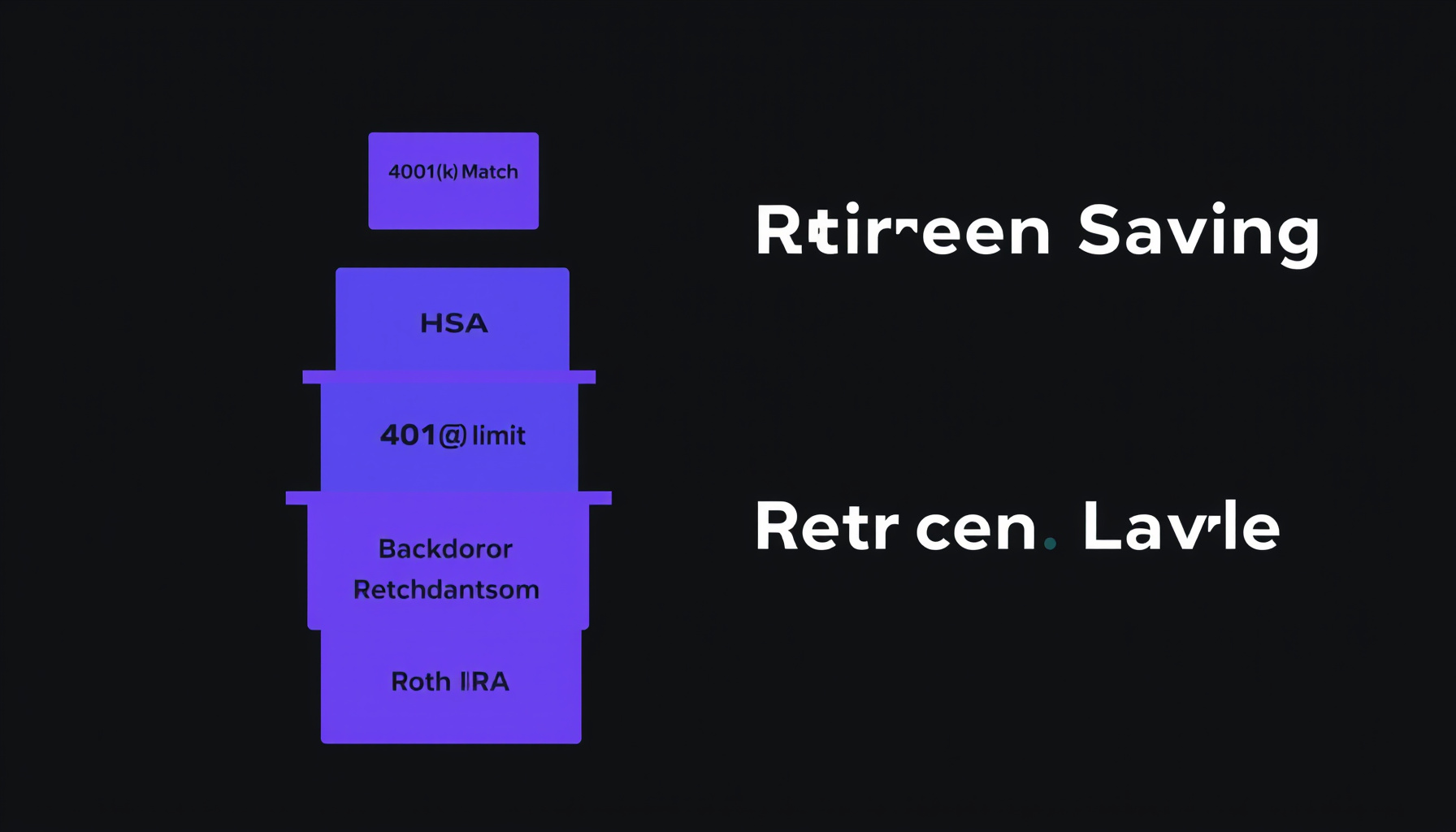
Retirement planning for tech professionals in 2026 comes down to a single, repeatable stack: secure the employer match, fund the HSA, max the 401(k), then use the backdoor and mega backdoor Roth strategies to push as much money into Roth accounts as the IRS allows. The 2026 contribution limits are higher across the board, and the window to act on them is open now. This guide walks through the exact numbers, the order of operations, and the traps that quietly cost six figures.
How This Guide Was Built
This guide is based on official IRS documentation, Fidelity/Vanguard/Schwab pages, and community reports. We verified the 2026 contribution limits, HSA rules, and mega backdoor mechanics against primary sources. We did not run these accounts hands-on — steps are based on official documentation. Last verified: August 2026.
How do tech professionals plan for retirement?
Tech professionals plan for retirement by stacking tax-advantaged accounts: employer match first, then an HSA, then the full 401(k) deferral, then backdoor and mega backdoor Roth contributions. The 2026 limits raise the 401(k) deferral to $24,500 and the IRA limit to $7,500, per the IRS Newsroom. The core question is routing every dollar through the fewest tax doors.
The 2026 retirement account limits you need to know
The 2026 contribution limits are set, and they’re higher across the board. The 401(k) deferral limit rises to $24,500, the IRA limit rises to $7,500, and the HSA family limit rises to $8,750, per the IRS Newsroom and IRS Rev. Proc. 2025-19. The table below shows the exact changes.
| Account Type | 2025 Limit | 2026 Limit |
|---|---|---|
| 401(k) deferral (under 50) | $23,500 | $24,500 |
| 401(k) catch-up (50+) | $7,500 | $8,000 |
| 401(k) catch-up (60-63) | $11,250 | $11,250 |
| Total 401(k) additions incl. employer match | $70,000 | $72,000 |
| IRA | $7,000 | $7,500 |
| IRA catch-up (50+) | $1,000 | $1,100 |
| HSA self-only | $4,300 | $4,400 |
| HSA family | $8,550 | $8,750 |
One new rule for 2026: if you’re 50+ and your prior-year FICA wages were $150,000 or more, your 401(k) catch-up contribution must go into a Roth account, not pre-tax, per the Federal Register TD 10033. Plan for the tax hit now.
Why the HSA comes before the Roth IRA on an HDHP
The HSA comes before the Roth IRA because it’s the only account with a triple tax advantage: contributions are deductible, growth is tax-free, and qualified distributions are tax-free, per IRS Pub 969. For 2026, the self-only limit is $4,400 and the family limit is $8,750, per IRS Rev. Proc. 2025-19.
Balances roll over year to year, so it doubles as a retirement account. If you’re on an HDHP, fund the HSA before the Roth IRA — the deduction is worth more than the Roth’s tax-free growth at most tech salaries. For a full breakdown of benefits trade-offs, see our tech benefits optimization guide.
The mega backdoor Roth: how to add $35,000+ of Roth space
The mega backdoor Roth lets you contribute after-tax money to your 401(k) beyond the $24,500 deferral limit, up to the $72,000 total annual additions cap, then convert it to Roth — adding more than $35,000 of extra Roth space a year, per Fidelity.
Using Fidelity’s worked example for 2026: $24,500 deferral + $12,250 employer match → max after-tax contribution = $72,000 - $24,500 - $12,250 = $35,250. That’s $35,250 of additional Roth space in a single year. The catch: your plan must allow after-tax contributions and in-plan conversion or in-service rollover — many don’t, per Fidelity. Only earnings on the after-tax money are taxable at conversion. Check your plan documents or ask HR before assuming this is available.
The backdoor Roth IRA: a $7,500 workaround for high earners
The backdoor Roth IRA is a two-step process: contribute non-deductibly to a traditional IRA, then convert that balance to a Roth IRA, per the IRS Rollovers page. For 2026, the IRA limit is $7,500, per the IRS 2026 limit announcement.
The catch: the pro-rata/aggregation rule applies if you hold any pre-tax IRA money — that includes rolled-over 401(k)s. If you do, the conversion is partially taxable. The fix is to roll pre-tax IRA balances into a current employer’s 401(k) before converting. This strategy is essential for tech professionals whose income exceeds the Roth IRA MAGI phase-out of $153,000-$168,000 (single) or $242,000-$252,000 (married filing jointly), per the IRS 2026 limit announcement.
The Roth conversion ladder: accessing retirement money before 59½
The Roth conversion ladder is the standard early-retirement withdrawal strategy: convert pre-tax 401(k)/IRA money to Roth, wait five years, then withdraw the converted principal tax-free and penalty-free before 59½. Each conversion has its own 5-year holding period starting January 1 of the conversion year, per Schwab.
Withdrawing converted funds within five years triggers the 10% penalty plus income tax on earnings, per Fidelity Roth conversion. The ladder works because you convert in low-income years, pay tax at a low rate, and then access the principal after the holding period expires. Start the ladder 5+ years before you need the money.
FIRE milestones that make sense on a tech salary
FIRE (Financial Independence, Retire Early) milestones on a tech salary are about hitting annual savings targets that compound, not a magic number. Assuming a 7% annual return (illustrative, not a promise): $10,000 invested at 25 grows to about $149,745 by 65, while the same $10,000 invested at 35 grows to about $76,123 — a 10-year delay costs about $73,622.
That’s the compounding argument for starting now. Industry-wide, across Vanguard’s ~1,400 plans, the average promised employer match is 4.6% of pay and the median is 4.0%, per the Vanguard How America Saves 2025 report. The median 401(k) balance for ages 25-34 is just $16,255, per the same report. Tech salaries allow you to blow past those medians — the milestone that matters is maxing every tax-advantaged bucket, not hitting a round number.
Mistakes that quietly cost tech professionals six figures
The biggest retirement mistakes for tech professionals are silent, compounding, and avoidable: leaving the employer match on the table (the average promised match is 4.6% of pay, per Vanguard), skipping the mega backdoor Roth, and holding pre-tax IRA money that triggers the pro-rata rule. Each costs tens of thousands over a career.
The fourth is ignoring the new 2026 Roth catch-up mandate for high earners 50+, which creates an unexpected tax bill if unplanned. The fifth is failing to convert after-tax 401(k) money promptly, letting earnings accumulate and become taxable at conversion. For a deeper look at how to avoid the high-income trap, see our guide to the high-income trap. And if you’re navigating equity compensation, our startup equity survival guide covers the RSU/ISO interplay with retirement accounts.
FAQ
What is the catch-up contribution for 2026?
The 2026 401(k) catch-up contribution for those 50+ is $8,000, per the IRS Newsroom. For those aged 60-63, the catch-up is $11,250, which debuted in 2025. The IRA catch-up for 50+ is $1,100. Note: if you’re 50+ with prior-year FICA wages of $150,000+, the 401(k) catch-up must be Roth.
Can I do a mega backdoor Roth and a backdoor Roth IRA in the same year?
Yes, you can do both in the same year. The mega backdoor Roth uses after-tax 401(k) space up to the $72,000 total additions cap, while the backdoor Roth IRA uses the $7,500 IRA limit. They are separate accounts with separate limits. The key distinction: the mega backdoor converts directly from the 401(k), avoiding the IRA pro-rata rule, per Fidelity.
How does the Roth conversion ladder work for early retirement?
The Roth conversion ladder converts pre-tax retirement funds to Roth, then waits five years before withdrawing the converted principal penalty-free. Each conversion has its own 5-year holding period starting January 1 of the conversion year, per Schwab. Under 59½, withdrawing converted funds within five years triggers the 10% penalty plus income tax on earnings. Plan conversions five years before you need the money.
For a broader view of how retirement accounts fit into your overall investment strategy, see our tech wealth-building investment strategies guide. And if you’re negotiating a new role, our tech salary negotiation guide covers how to value the 401(k) match as part of total compensation. Finally, explore our career tools to model your own retirement projections.
← Back to all posts